Art That Belongs in Your Community
The Tarbell Charitable Trust believes that great art should not wait behind closed doors. Through the TCT Lending Library, qualifying institutions can bring original works by Edmund Charles Tarbell into their communities.
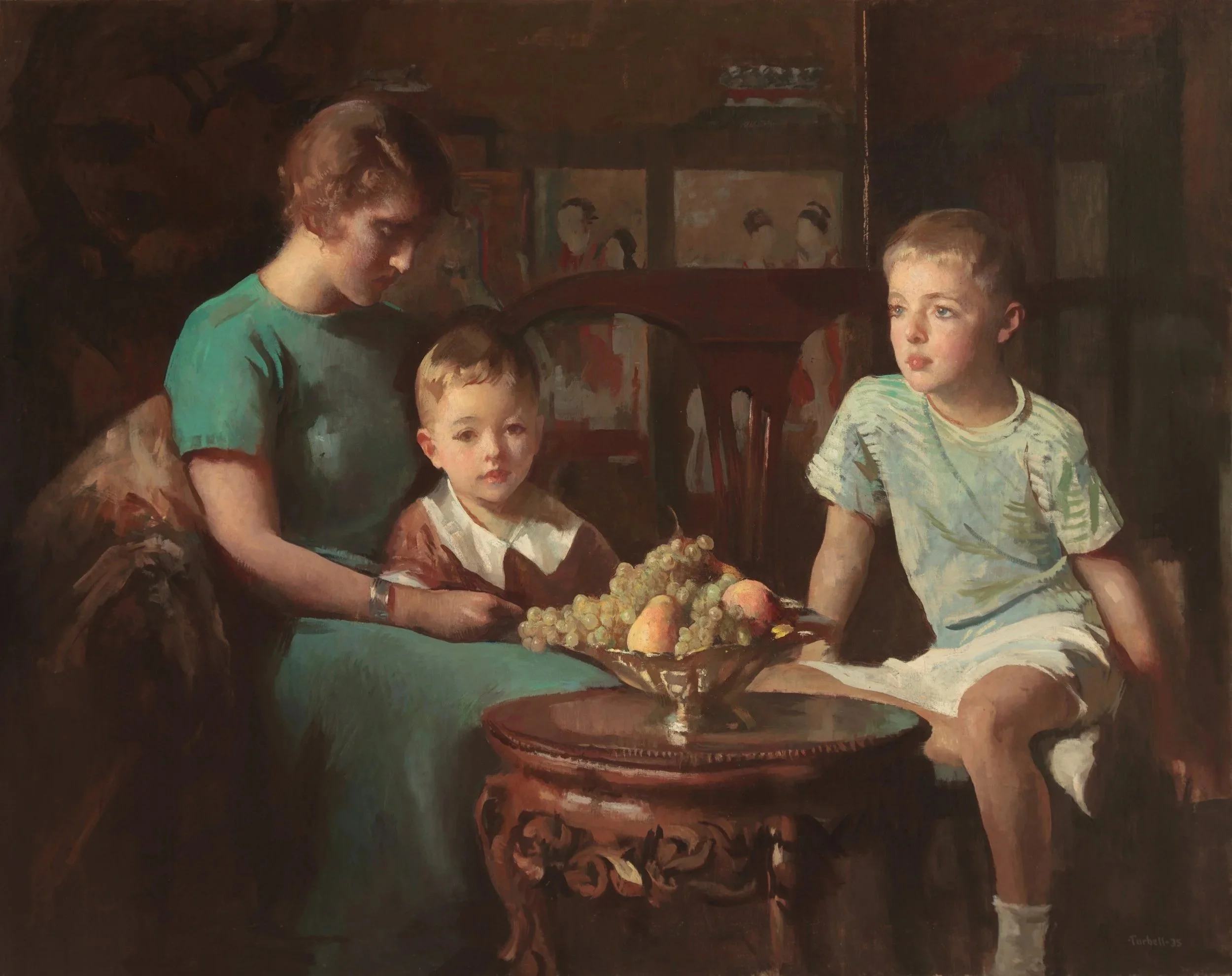
Marjorie, Danny and Little Edmund currently on loan at the Groton Public Library
Art that Works in the World and Educates All
Edmund Charles Tarbell painted family and others in balanced light. Daniel Wesley Badger Tarbell believed the beauty of ECT work should be shared by all — it belongs to the people willing to stop and look for it.
The Tarbell Charitable Trust carries that belief into everything it does. The Lending Library is one expression of it. When a Tarbell painting hangs in a public library or a school hallway, it does what ECT intended — it stops people in their tracks and reminds them that real human beings have stories worth paying attention to.
The Groton Public Library has housed rotating works from the Trust's collection for years. The Groton Historical Center and also the Groton Library have featured the works of Edmund Charles Tarbell through the generosity of the Trust. Visitors describe them as paintings with lightness and gravity — work that makes you feel the person looking back at you is real, and that their story matters.
That is what we want to bring to your community.
“We recently dedicated a room in the Boutwell House to renowned artist Edmund Charles Tarbell featuring several of his works, along with biographical information that highlight his life and artistic legacy. Being able to share his life story and remarkable contributions to American art is a gift we are proud to offer the public.”
Works Available for Loan
We welcome inquiries from institutions about the Trust’s collection.
Works from the Trust's collection rotate on a scheduled basis.
If a specific work you are interested in is not currently available, we encourage you to inquire —
availability changes throughout the year.
Oil Paintings
-
My Family at Cotuit
c. 1900
Oil on canvas
25 × 30½ inches
Painted during the Tarbell family’s summers in Cotuit, Massachusetts, this charming group portrait predates the family’s move to New Castle, New Hampshire, and marks one of the earliest depictions of Tarbell’s growing family. Emeline Tarbell sits quietly at left while their children, Josephine, Edmund, Mary, and Mercer, are arranged naturally across the landscape, reflecting the artist’s gift for transforming everyday family life into timeless works of art.
Unlike the carefully staged interiors for which Tarbell became famous, My Family at Cotuit embraces the light and atmosphere of the outdoors while retaining the intimacy that defines his finest paintings. Today, it stands as an important record of the family before New Castle became the setting for so many of Tarbell’s best-known works.
——————————————————
Oil Painting - One of ECT’s wonderful impressionist works is My Family at Cotuit (about 1900).
Cotuit was a small Cape Cod community. Everyone except their older daughter is dressed in summer white. This contrasts with the crystal blue ocean water glistening in the background. Josephine stands out in her pink dress even though she is quietly reading. Her idle hand rests on her baby brother’s umbrella covered carriage. To the her left is the youngest daughter, Mary. The middle sister, Mercie, rides a toy horse. On the far left their mother, Emeline, is playing with baby Edmund. Edmund Arnold Tarbell completed the family and was their only son. He was born during a family holiday at New Castle (June 1898). The only missing member of the family is their Russian Wolfhound, Sergius, acquired when the chidren were older.
-
Portrait of Mrs. Jonathan Sawyer
1936
Oil on canvas
45 × 32 inches
Painted during the final years of Tarbell’s career, this elegant portrait reflects the quiet confidence and technical mastery that distinguished his late work. Rather than relying on elaborate settings or accessories, Tarbell allows the sitter’s expression and presence to carry the composition, creating a portrait of dignity and warmth.
Exhibited in the 1938 memorial exhibition at the Museum of Fine Arts, Boston, the painting represents Tarbell’s continued success as one of America’s most sought-after portrait painters.
The painting features Mrs. Sawyer seated elegantly in a soft, natural light. Tarbell employs a rich color palette, emphasizing warm tones and delicate details. The composition highlights Mrs. Sawyer's serene expression and graceful posture. The background is softly blurred, drawing focus to the subject. Tarbell's brushwork showcases his mastery of texture, particularly in fabric and skin tones. The overall mood conveys a sense of intimacy and quiet reflection.
-
Marjorie, Edmund and Little Daniel
1935
Oil on canvas
40½ × 50½ inches
Completed just a few years before Tarbell’s death, this affectionate family portrait depicts his daughter-in-law Marjorie with his grandsons Edmund and Daniel. The relaxed composition reflects the warmth of family life while demonstrating the mature balance and color harmony that characterize Tarbell’s late work.
-
Portrait of Myself
c. 1937
Oil on canvas
14¼ × 12¼ inches
One of Tarbell’s final self-portraits, this intimate likeness was painted near the end of an extraordinary career. Dressed in academic robes believed to commemorate his honorary Doctor of Fine Arts degree from Dartmouth College, Tarbell presents himself with quiet honesty and confidence.
-
Edmund, Mary and Sergius
1920
Oil on canvas
50 × 40 inches
Tarbell portrays his youngest children, Edmund and Mary, accompanied by the family’s Russian wolfhound, Sergius. The carefully balanced composition celebrates the artist’s devotion to family while demonstrating the refined color harmonies of his mature style.
—————————————————-
Edmund, Mary and Sergius by Edmund Charles Tarbell, 1920
Tarbell painted here his two youngest children Edmund and Mary (at the ages of 22 and 24 respectively) and the family’s Russian Wolfhound, Sergius. -
Still Life with Irises and Blue Jar
1918–1924
Oil on canvas
25 × 21 inches
Brilliant purple irises spill beside a striking blue-and-white ginger jar, one of several treasured objects that appears throughout Tarbell’s work. Painted with fresh, confident brushwork, the composition transforms familiar flowers and household objects into a work of remarkable beauty.
-
Still Life with Roses and Two Jars
1918–1924
Oil on canvas
25 × 30 inches
Flowers from Tarbell’s New Castle gardens and carefully chosen ceramics come together in this elegant still life. The painting reflects the same harmony of color, light, and design that distinguishes his celebrated portraits and interiors.
-
Portrait of Henry Clay Frick
1910
Oil on canvas
26 × 20 inches
Correspondence preserved in the Archives of American Art documents Tarbell’s repeated attempts to arrange a sitting with Henry Clay Frick. Unable to meet because of Frick’s declining health, Tarbell relied upon photographs to complete the portrait, demonstrating his remarkable ability to capture a compelling likeness without a formal sitting.
———————————————-
The portrait captures Frick's imposing presence and business acumen.
Tarbell employs a realistic style, emphasizing detail and texture in Frick's attire.
The use of light and shadow highlights Frick's facial features and expression.
The background is subtly rendered, focusing attention on Frick himself.
The color palette is muted, reflecting the seriousness of Frick's character.
The painting conveys a sense of power and authority, characteristic of Frick's legacy.
-
Early Shore Scene
1883
Oil on canvas
14 × 20 inches
Among the earliest paintings in the Trust collection, this small coastal landscape dates from the year Tarbell departed for Paris to study at the Académie Julian. Its early signature and atmospheric handling provide a fascinating glimpse of a young artist on the threshold of a remarkable career.
-
Portrait Study of Timothy Dwight
c. 1911
Oil on canvas
36 × 31 inches
Painted in preparation for Tarbell’s formal portrait of Yale University President Timothy Dwight, this study captures the sitter’s expression with remarkable economy. Recently gifted to the Trust, it offers a rare glimpse into Tarbell’ss working process.
——————————————————
The portrait depicts Timothy Dwight, a prominent educator and theologian, who served as Yale's president.
Tarbell's style combines realism with impressionistic elements, emphasizing light and texture.
The composition features Dwight in academic regalia, symbolizing his scholarly achievements.
The background includes soft, muted colors that enhance Dwight's dignified presence.
The painting reflects the early 20th-century American art movement, showcasing Tarbell's mastery of portraiture.
It serves as a historical artifact, representing Yale's legacy and the importance of its leadership.
-
On the Fens
c. 1914
Oil on canvas
12 × 16 inches
Painted around 1914 while Tarbell was teaching at the School of the Museum of Fine Arts, Boston, this intimate landscape captures the quiet beauty of the Fenway.
Confident brushwork, subtle color harmonies, and tranquil reflections transform a familiar Boston scene into a distinctly Impressionist work. Recently gifted to the Trust, it is one of the newest additions to the collection.
Works on Paper
-
Shore Birds
Frank W. Benson
Etching
Frank W. Benson and Edmund C. Tarbell shared one of the closest friendships in American art. Classmates at the School of the Museum of Fine Arts and later at the Académie Julian in Paris, they returned to Boston to teach together and became leading figures of the Boston School. This print reflects that lifelong friendship and mutual respect while reminding visitors of the artistic circle that shaped American Impressionism.
-
Edmund and Sigh of the Sea
1916
Pastel and pencil on paper
9 × 9¾ inches
This intimate drawing depicts Tarbell’s son Edmund with the family’s horse, Sigh of the Sea.
Executed with remarkable economy, the work demonstrates the artist’s ability to capture character and movement with only a few carefully observed lines. It also reflects Tarbell’s lifelong interest in horses, a subject that appears throughout his later work.
-
Edmund and Eaglet
Drawing
One of several studies of Tarbell’s son with the family’s Arabian horse, Eaglet, this drawing captures a quiet moment between rider and horse. Rather than creating a finished composition, Tarbell concentrated on gesture and relationship, revealing the thoughtful process behind many of his equestrian paintings.
-
To Edmund from Father
c. 1935
Pencil and charcoal on paper
7¾ × 10 inches
Inscribed ‘To Edmund from Father on Christmas’, this delicate drawing was presented by Tarbell to his son and is believed to be a study for Mary Mending a Glove. With only a few graceful lines, Tarbell established the elegant profile and dramatic hat that would later define the finished painting. The drawing is both a treasured family keepsake and a rare glimpse into the artist’s creative process.
-
Mary and New Castle Poppy
c. 1915–16
Charcoal on blue paper
18 × 10½ inches
Few drawings better demonstrate Tarbell’s extraordinary draftsmanship than this portrait of his daughter Mary with her horse, New Castle Poppy. Executed on blue paper with bold charcoal and delicate highlights, the drawing possesses an immediacy and confidence all its own. The image later became one of Tarbell’s most widely recognized graphic works through reproduction by the Guild of Boston Artists.
-
Marjorie and Danny
c. 1935
Pencil on paper
23½ × 17½ inches
Drawn as a study for Marjorie, Edmund and Little Daniel, this preparatory sketch focuses on the relationship between Marjorie and young Daniel before Tarbell developed the finished composition. Such studies reveal the careful observation and planning that lay behind even his most natural family portraits.
-
To Miss Tanner
1923
Drawing
Created for Portsmouth’s Tercentenary celebration in 1923, this spirited drawing depicts the Ranger and adapts an earlier composition by Portsmouth artist Marshall Johnson Jr.
Tarbell’s design was selected for the official Tercentenary publication and later presented to Virginia Tanner, whose leadership helped make the celebration a success. The drawing reflects both Tarbell’s enduring connection to Portsmouth and his willingness to contribute his talents to an important civic event.
How to Request a Loan
01
Check Eligibility
The TCT Lending Library is available to qualifying institutions including public libraries, schools, historical societies, community centers, and cultural organizations. Private individuals are not eligible for the lending program.
02
Submit a Request
Complete the loan request form below with details about your institution, the works you are interested in, your proposed exhibition dates, and your facility's environmental and security conditions.
03
Review & Agreement
The Trust reviews all loan requests and responds within a designated timeframe. Approved loans require a formal loan agreement covering installation standards, insurance requirements, handling protocols, and return arrangements.
04
Installation & Loan Period
Once the agreement is signed, the Trust coordinates delivery, installation support, and the loan period schedule. Works are loaned for a defined period and returned at the close of the loan term.
“The portraits that we have hanging here are of his family, so it’s even more intimate. They’re magnificent. They just are. It’s a pleasure to see every day.”
Request a Loan for Your Institution
We welcome inquiries from libraries, schools, historical societies, and cultural organizations. Complete the form to begin the conversation.